Table of Contents



Video Presentation, on YouTube
Introduction and Context
The Space Age began in 1957 with the successful launch and entry into orbit of Sputnik-1 by the USSR. In the subsequent sixty-eight years, space technology has become an essential part of modern life. From GPS navigation to weather forecasting, communications, defence, Earth imaging and scientific exploration, satellites underpin much of our daily existence. This report discusses a growing existential threat against use of space technology to support our way of life.
Earth’s orbit has become increasingly congested with satellites, rocket stages, and debris fragments from past missions. While many of these objects decay naturally over time or are purposefully caused to re-enter the atmosphere, a huge number remain in orbit many years after launch. Even small fragments as tiny as a paint fleck can damage spacecraft when travelling at orbital speeds (7–8km/s).
The congestion in orbit means that collisions already occur between objects. As the number of objects in orbit grows, there is an increased chance that occasional collisions will happen. Each impact generates more fragments, in turn increasing the likelihood of additional collisions. The most severe accident so far is the 2009 collision between Iridium-33 and Cosmos-2251, which generated more than 1,800 pieces of debris (Johnson 2009).
In 1978, Donald J. Kessler and Burton G. Cour-Palais authored a paper which describes a scenario whereby the density of objects in Low Earth Orbit (LEO) reaches a tipping point (Kessler 1978). Under this model, collisions between objects become a cascade, creating a debris cloud and causing more objects to collide until all satellite payloads have been destroyed. A Low Earth Orbit devoid of usable safe orbits would be catastrophic for modern civilisation; the resultant debris could last many generations.

While catastrophic cascading has not yet occurred, incidents such as Iridium-Cosmos demonstrate that the risk is real. The 2013 film “Gravity” depicts a Kessler cascade, which destroys most orbiting satellites, including the International Space Station (ISS), and kills nearly everyone in orbit (Cuarón 2013).
This report will answer the following questions:
- What is the current state of orbital congestion, and how has it evolved since space exploration began in the late 1950s?
- What trends in satellite launches are driving the risk of Kessler Syndrome?
- How do different nations and private firms contribute to orbital congestion?
- What mitigation strategies are feasible?
The hypothesis is that without coordinated international regulation, and active debris removal, orbital congestion will reach a tipping point within the next few decades. To test this assertion, this report will analyse available data on objects that are in orbit, along with launch trends to assess the likelihood and potential impact of the Kessler Syndrome.
This report seeks to show that this is not a distant theoretical risk, but as an imminent danger shaped by seven decades of satellite launches and accelerating commercially led activity.
By examining orbital conditions, launch trends, and mitigation strategies, the report aims to provide a comprehensive understanding of the issue. The goal is to highlight the necessity of international cooperation and technological innovation to ensure that Earth’s orbital environment remains a useful resource.
NB: The charts and figures in this report are based on data last updated on 1st December 2025.
| Terminology | Definition |
|---|---|
| Payload | A satellite, space craft or permanent space station. |
| Debris | Trackable objects over 10cm (4 inches) in size. This is the current threshold for possible monitoring. |
| Component | Small objects, such as rubbish bags, gloves, lost tools. |
| Rocket Body | Piece of a launch vehicle, such as a rocket stage or booster engine. |
Orbital Congestion: Changes Over Time
The early decades of spaceflight were dominated by military and geopolitical competition; the Cold War led to rapid satellite proliferation. The main players in deployment were the USA and the USSR; few other countries had the resources to develop payloads or to fund launches. The UK Government used NASA rockets to launch its first satellites named Ariel 1–3 in 1962, 1964 and 1967 respectively.
In the 1950s and 60s, satellite technology was mainly focused on defence capability and on space exploration. While there was some private commercial interest, most satellite programs were government backed (Figure 2).
NEEDS FIGURE JUST SHOWING COUNT PER CLASS OVER TIME

From the 1990s onward, while government sponsored launches declined, more private companies started to become interested in space. Many became interested in launching satellites for telecommunications, Earth observation and imaging, and navigation. Google Earth, for example, utilised NASA satellites for commercial purposes. This shift introduced new stakeholders to space technology and accelerated growth and competition.
The 24 payloads involved in the first full GPS constellation went live.
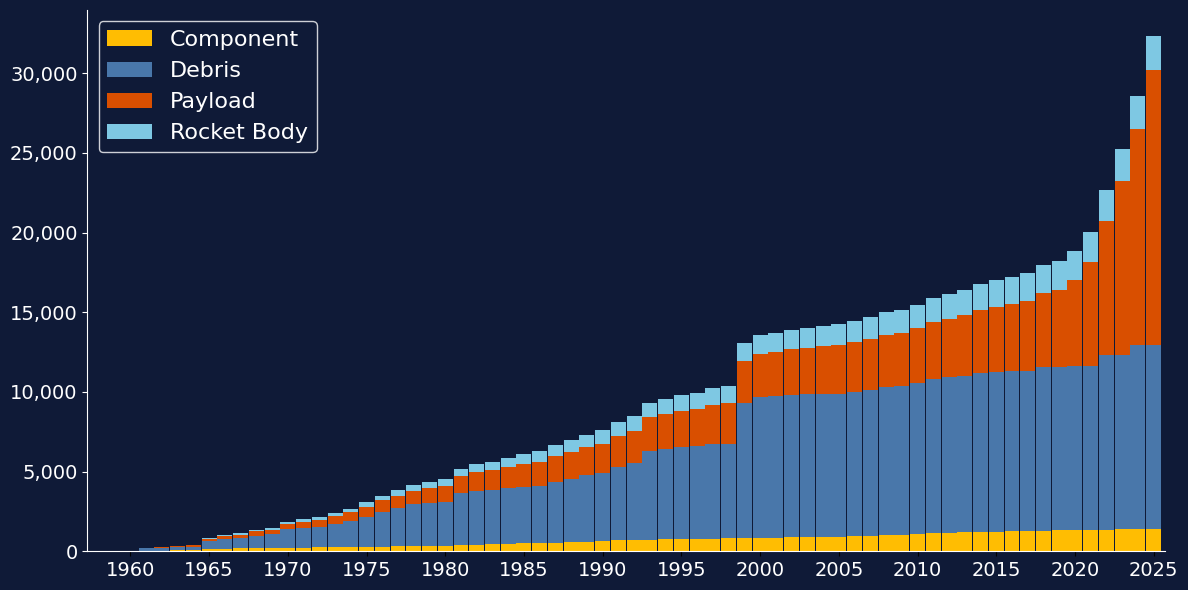
Early space missions left debris in orbit without much thought for long‑term sustainability. The late 1990s saw a notable collision between an Ariane rocket piece and the French Cerise satellite (Alby 1997). At this time, rocket bodies often broke up, increasing the debris count significantly, as shown in Figure 3, leading to guidelines around improving sustainability and debris reduction (COPUOS 1999).
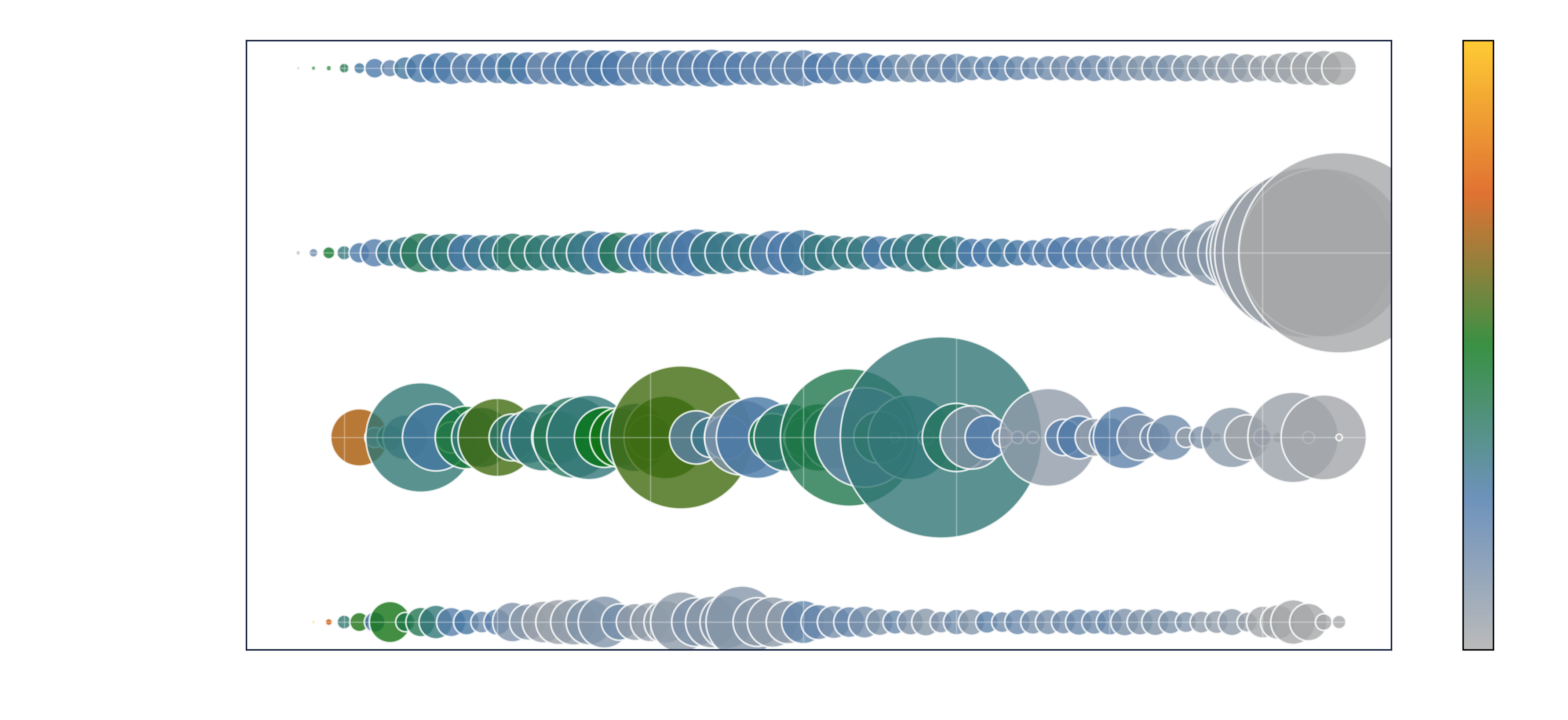
The late 2010s and 2020s have marked a turning point, with firms like SpaceX, OneWeb, and Amazon becoming the majority stakeholders in satellite deployments. Figure x below also shows a recent increase in the deployment of defence capability, which may be a reaction to global hostilities.
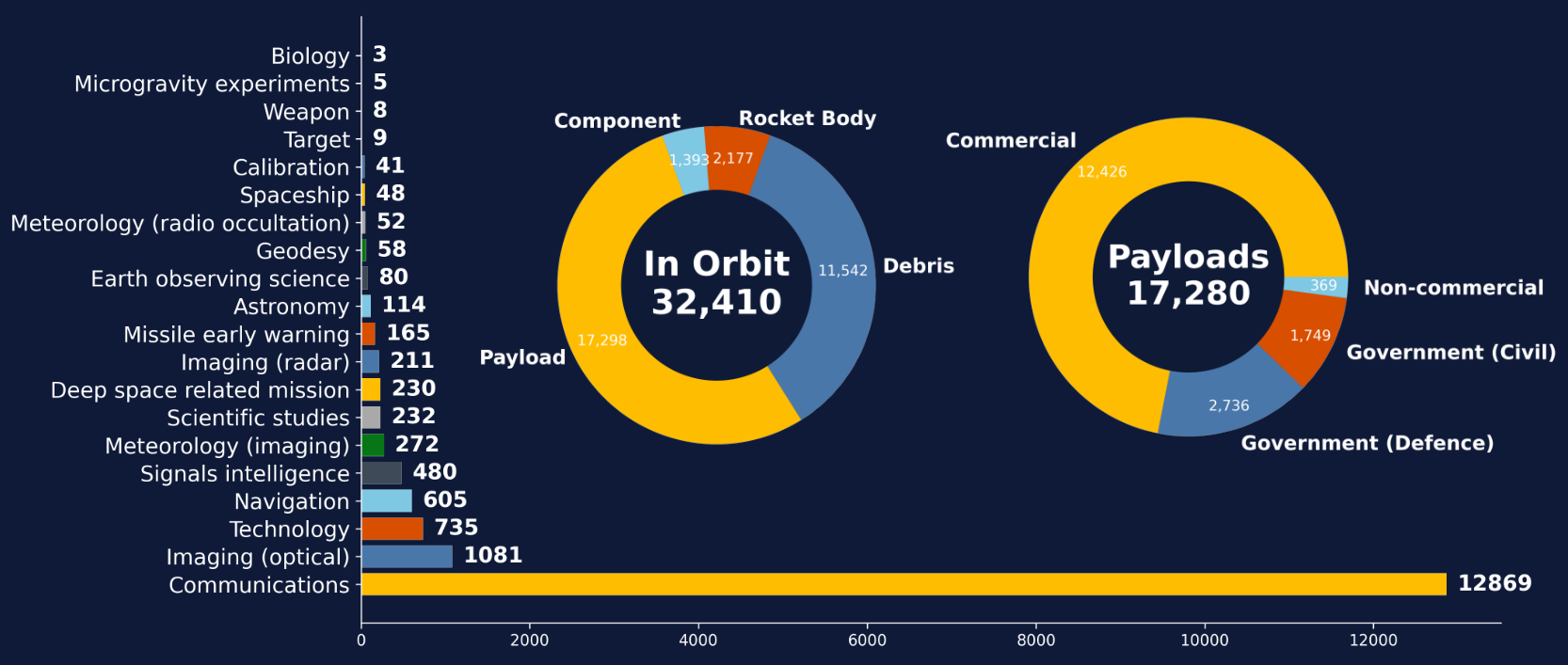
At the time of writing in early December 2025, there are over 32,000 tracked objects, and many millions more that are too small to monitor. Around 17,300 objects are satellite payloads, although many are no longer in active service. Russia continues to operate a large fleet of military and civilian satellites, while the USA maintains extensive constellations for communications, navigation, and Earth observation.
Objects in Orbit and Their Growth
Figure 5 below shows a breakdown of objects by type and category.
The number of objects in orbit has grown over time, as the number added has increased faster than objects have re-entered the atmosphere, as shown in Figure 7.

The total mass of the satellite payloads in orbit is 13,174 metric tons, which is the same as 1,062 London buses (London Assembly 2014). Figure 8 shows the relative mass by category and of the top twenty satellite programs. The bulk of the global satellite fleet are commercial communications devices.

Trends Driving Kessler Syndrome Risk
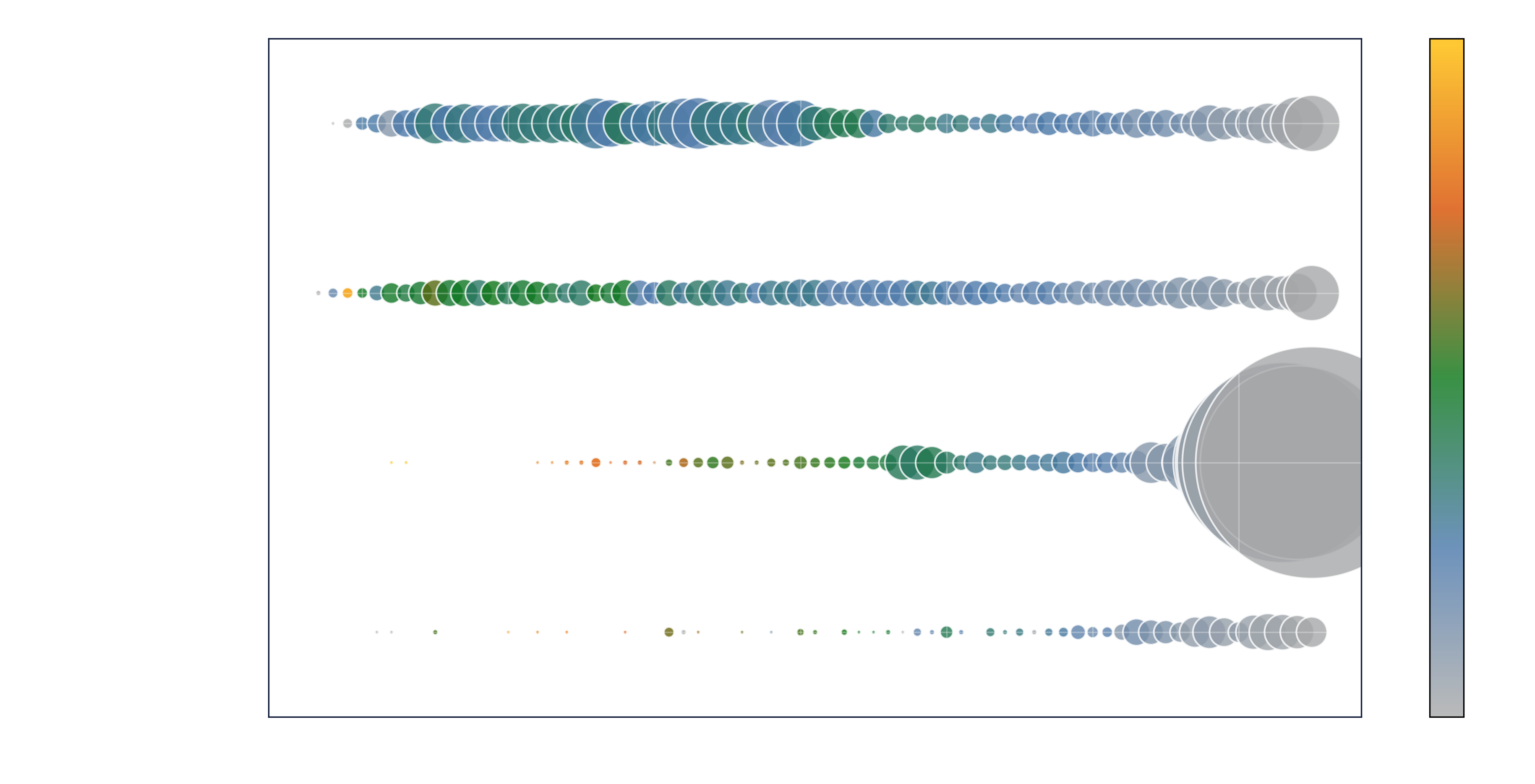
The most significant trend of the past decade has been the concept of mega-constellations. Companies like SpaceX, OneWeb, and Amazon plan to deploy tens of thousands of satellites in Low Earth Orbit. These constellations rely on mass production of identical payloads. This scale is unprecedented compared to earlier decades.
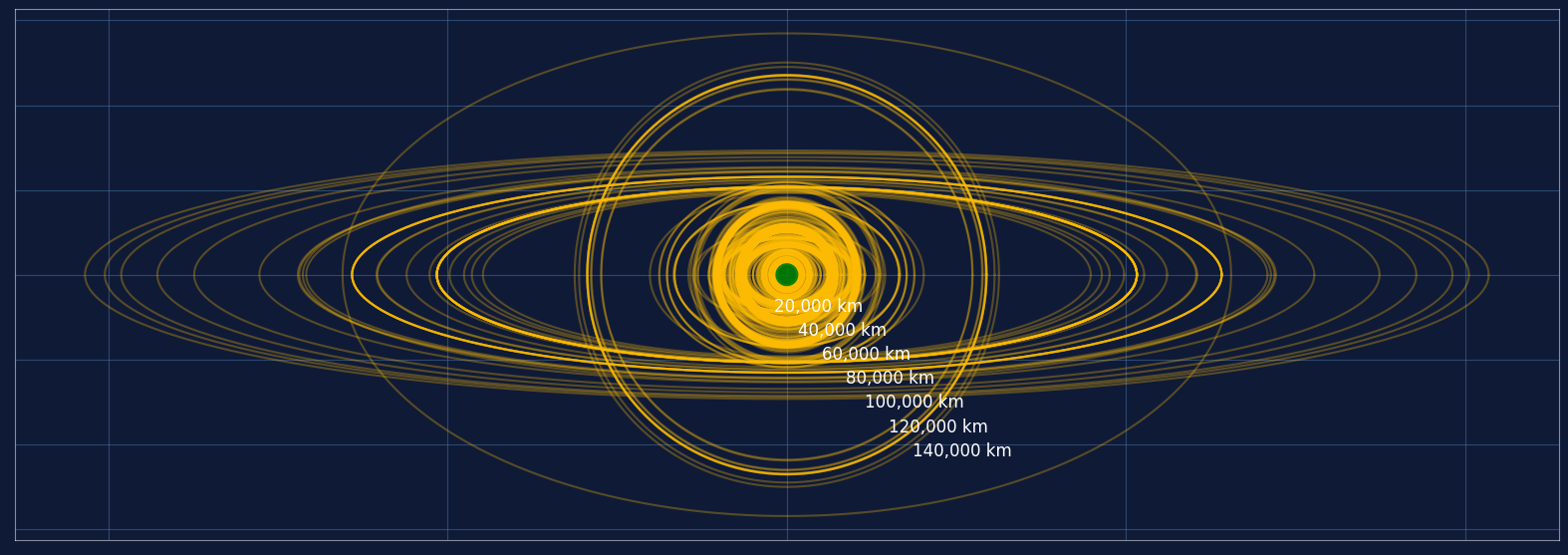
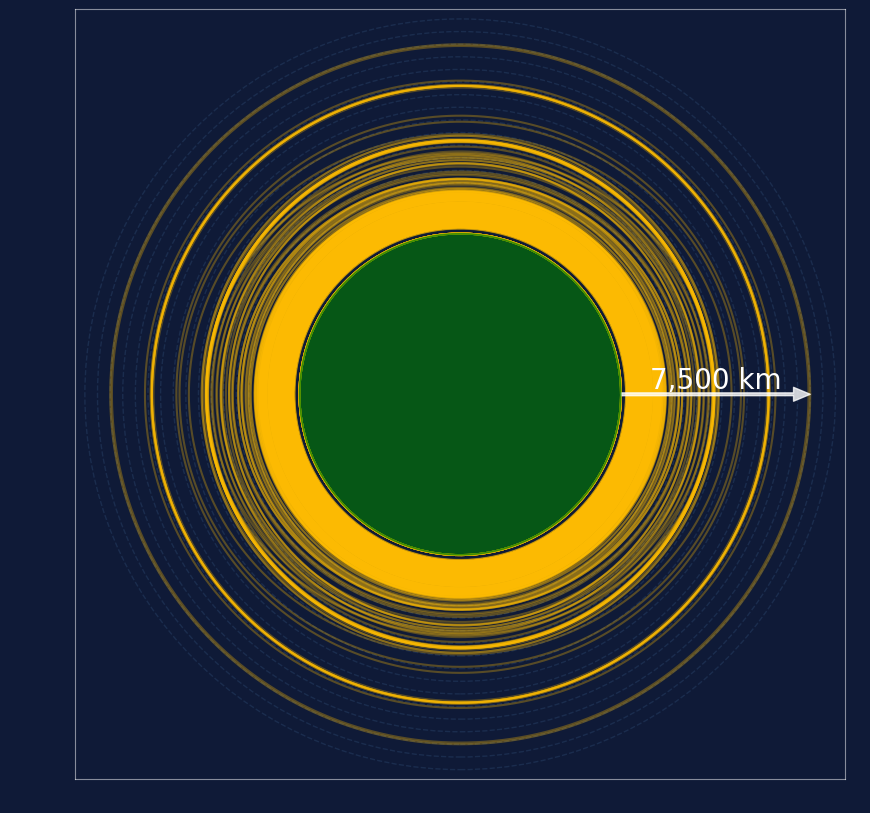
Low Earth Orbit, particularly altitudes between 500–1,200 km, is the most crowded region due to communications and Earth imaging satellites. SpaceX aims to replace cell towers for standard mobile telephones in remote areas, which necessitates a very low orbit (SpaceX 2025).
Figure 9 shows how congested the orbital shells are very close to the Earth.
</figure>
</figure>
Another trend is the diversification of launch providers. Nations such as China and India are rapidly expanding their fleets, while private firms worldwide are lowering launch costs through reusable rockets.
Finally, shorter satellite lifespans are contributing to a growing population of defunct and inactive spacecraft.
National and Commercial Contributions to Congestion
The current levels of payload density are the cumulative result of decades of activity by both national space agencies and private firms.
Historically, the United States and the Soviet Union (later Russia) were the primary contributors, launching thousands of satellites and rocket stages during the Cold War. In recent decades, China has emerged as a major player, with rapid expansion of its satellite fleet and the construction of the Tiangong space station. India, Japan, and the European Union also now contribute significantly.
Most launches in the 2020s have been sponsored by commercial organisations.
SpaceX, the American firm owned and run by Elon Musk, launched its first satellite in 2018. It has experienced incredible growth in the following seven years and there are now 9,092 Starlink satellites in orbit. The company aims to launch many more Starlink satellites to increase coverage and bandwidth for global Internet access, and to improve cellular phone communications (Starlink 2025, Pultarova 2025).
Earlier in the Starlink program around 2019, each Falcon 9 launch carried up to sixty satellites per flight. This number has decreased over time due to the satellites becoming larger and more capable. As of October 2025, SpaceX typically launches 28 Starlink satellites per mission (Robinson-Smith 2025). As a side issue, each Falcon 9 launch emits approximately 336 metric tons of CO₂, contributing to climate change (Franklin-Cheung 2020).
OneWeb and Amazon’s Project Kuiper are also planning mega-constellations.
Mitigation Strategies
Mitigating the risk of Kessler Syndrome requires a combination of technological, regulatory, and operational strategies.
One possible approach is active debris removal, where robotic spacecraft capture and de-orbit large defunct satellites or rocket stages. Methods include nets, robotic arms, and atmospheric drag sails. ESA’s planned ClearSpace‑1 mission aims to demonstrate active debris removal (ESA 2020).
Another strategy is design for de-orbit, where satellites are engineered to burn up in Earth’s atmosphere at the end of their lifespan, either through fuel reserves or passive devices like drag sails.
Collision avoidance systems are increasingly used, with satellites equipped to manoeuvre away from predicted collisions. Operators must regularly adjust trajectories, balancing reduced lifespans due to fuel exhaustion. Starlink made 26,000 avoidance corrections from 2020 to 2022 (Universe 2023).
On the policy side, international guidelines such as those from the UN and national space agencies encourage debris mitigation practices. The Space Debris Mitigation Guidelines issued by the United Nations Committee on the Peaceful Uses of Outer Space (COPUOS 1999) and the IADC Space Debris Mitigation Guidelines (IADC 2025) set out voluntary measures for debris prevention, disposal, and collision avoidance.
Part 4 Discussion
The results highlight several key bottlenecks that complicate effective management of orbital congestion.
Firstly, there are limitations to tracking and monitoring debris and components. While objects over 10cm can be monitored, smaller fragments are difficult to detect and yet pose significant collision risks. Even a 1mm object can cause serious damage at orbital speeds (ESA 2023).
Secondly, coordination and cooperation barriers exist between countries and private firms. Regulatory frameworks and agreements, such as the COPUOS (1999) and IADC (2025) guidelines, provide some governance, but adherence is largely voluntary and inconsistent.
Thirdly, economic constraints hinder clean-up initiatives. While designing new satellites to de-orbit at their end of life is relatively cheap, the cost of actively removing old hardware and debris is likely to be prohibitive; there are no direct financial incentives to do so.
Finally, the rapid growth of mega-constellations increases orbital density, exponentially increasing risks that existing collision management systems struggle to address.
The central question is whether current practices are likely to result in a Kessler collision cascade. There are observed gaps in monitoring, regulation, and mitigation of existing orbiting objects, while commercial interests push to launch more payloads into Earth’s orbit. Meanwhile, collisions between spacecraft and debris occur regularly, causing damage.
The hypothesis that without coordinated international regulation and active debris removal, orbital congestion will reach a tipping point within the next few decades appears to have some merit. Whether this report’s goal—to inform stakeholders, raise the alarm, and encourage investment in sustainable orbital practices—is reached remains to be seen.
References
- , Collision of Cerise with Space Debris, ResearchGate, Access on: 28/11/2025
- , The super fast color palettes generator!, Coolors, Accessed on: 24/10/2025
- , Choosing suitable color palettes for accessible and accurate science figures, Current Protocols, 4, e1126. doi: 10.1002/cpz1.1126, Wiley Online Library. Accessed on: 24/10/2025
- , Space Debris Mitigation Guidelines of the Committee on the Peaceful Uses of Outer Space, UNOOSA, Accessed on: 21/11/2025
- , Gravity (Movie), Information available at: IMDb, Accessed on: 24/10/2025
- , ClearSpace-1 Mission, ESA, Accessed on: 21/11/2025
- , Can space exploration be environmentally friendly?, Science Focus, Accessed on: 12/11/2025
- , IADC Space Debris Mitigation Guidelines, UN Documents, Accessed on: 21/11/2025
- , The Collision of Iridium 33 and Cosmos 2251: The Shape of Things to Come, NASA NTRS, Accessed 28/11/2025
- , Understanding the misunderstood Kessler Syndrome, Aerospace America, Accessed on: 25/10/2025
- , Collision Frequency of Artificial Satellites: The Creation of a Debris Belt, Journal of Geophysical Research, Vol. 83, No. A6, pp. 2637-2646.
- , Chart Suggestions Guide, Tableau Public, Accessed on: 25/10/2025
- , Three Chinese astronauts stranded in space after debris hits their return capsule, LiveScience, Accessed on: 05/11/2025
- , New Bus for London - vehicle weight, London.gov, Accessed on 01/12/2025
- , Universe’s mysteries may never be solved because of Trump’s Nasa cuts, experts say, The Guardian, Accessed on: 26/11/2025
- , General Catalog of Artificial Space Objects, Planet4589, Accessed 24/10/2025
- , Pierced Canadarm2, ESA, Accessed on: 26/11/2025
- , Visualization Analysis and Design, CRC Press, Boca Raton.
- , Satellite Database, N2YO, Accessed: 16/10/2025
- , Tracking Satellites and Space Debris in Earth Orbit (Feb 2024), NASA SVS, Accessed on: 26/11/2025
- , NASA Master Catalog, NASA Data, Access attempted on: 13/10/2025 (NB: times out)
- , Open-source geocoding with OpenStreetMap data, Nominatim, Accessed on: 21/11/2025
- , How many satellites can we safely fit in Earth orbit?, N2YO, Accessed on: 16/10/2025
- , Starlink satellites: Facts, tracking and impact on astronomy, Space.com, Accessed 12/11/2025
- , SpaceX buys wireless spectrum from EchoStar in $17 billion deal, Reuters, Accessed on: 21/11/2025
- , The Future of Starlink Direct to Cell, SpaceX, Accessed on: 12/11/2025
- , Who's going to fix the space junk problem?, Space.com, Accessed on: 12/11/2025
- , SpaceX launches 28 Starlink satellites on 550th Falcon-9 mission, Spaceflight Now, Accessed on: 12/11/2025
- , UCS Satellite Database, UCS, Accessed: 13/10/2025
- , Starlink satellites performed 26 thousand avoidance maneuvers, Universe Magazine, Accessed on: 12/11/2025